
Sustainability has shifted from a marketing talking point to an operational expectation across hospitality, food service, and retail. One of the most visible changes has been the move from plastic to paper straws. For many businesses, this decision is framed as a clear environmental win. Yet behind the optics lies a more complex question for operators, procurement managers, and owners: are paper straws genuinely reducing operational costs, or quietly increasing them?
The Real Cost Beyond the Unit Price
At face value, paper straws are almost always more expensive than their plastic counterparts. Plastic straw manufacturing is highly optimized, relying on low-cost raw materials and efficient global supply chains. Paper straws require additional processing, stronger fibers, and often multiple layers or coatings to prevent rapid breakdown in liquid. For high-volume venues, this per-unit difference compounds quickly, turning a marginal increase into a noticeable monthly expense.
However, direct purchase price tells only part of the story. True operational cost includes everything required to source, store, use, replace, and dispose of a product. Paper straws often come with higher minimum order quantities and fewer supplier options, limiting purchasing flexibility. Overstocking ties up cash and storage space, while underestimating demand can result in rushed reorders at premium prices. Over time, these supply chain constraints quietly add to overhead.

Operational Friction on the Floor
Paper straws also introduce day-to-day operational friction. Unlike plastic, they behave differently in drinks designed to be consumed slowly. Cocktails, milkshakes, smoothies, and soft drinks served over extended periods often require replacement straws.
Each replacement carries a hidden cost: staff time, interruptions to service flow, and reduced efficiency during peak hours. Individually, these moments seem insignificant. Collectively, they affect labor productivity, table turnover, and overall service rhythm — factors that directly influence profitability.

Waste Management and Disposal Realities
Waste management further complicates the economics. Although paper straws are widely perceived as recyclable, many cannot be processed through standard recycling streams due to food contamination or mixed materials. Some include plant-based coatings that disqualify them from paper recycling altogether.
When disposal rules are unclear, contamination increases. This can lead to higher waste handling fees, rejected recycling loads, or additional sorting labor. In practice, a sustainability-driven switch can unintentionally increase waste-related costs if systems and education do not evolve alongside the product.

Customer Perception: Asset or Liability?
Customer perception is where paper straws may begin to offset some of these financial pressures. Consumers increasingly expect visible sustainability measures, particularly in hospitality environments. Paper straws function as a clear signal of environmental awareness and corporate responsibility.
For some brands, this alignment strengthens loyalty, supports premium positioning, and enhances reputation. These benefits are difficult to quantify, but they influence long-term brand equity and purchasing behavior in meaningful ways.
However, perception is fragile. When sustainability measures compromise user experience, goodwill erodes quickly. Complaints about soggy straws, altered taste, or reduced durability can overshadow environmental intent. In these cases, businesses absorb higher costs while simultaneously damaging customer satisfaction. Sustainability leadership requires balancing symbolism with functionality, not choosing one at the expense of the other.

Looking at Total Cost of Ownership
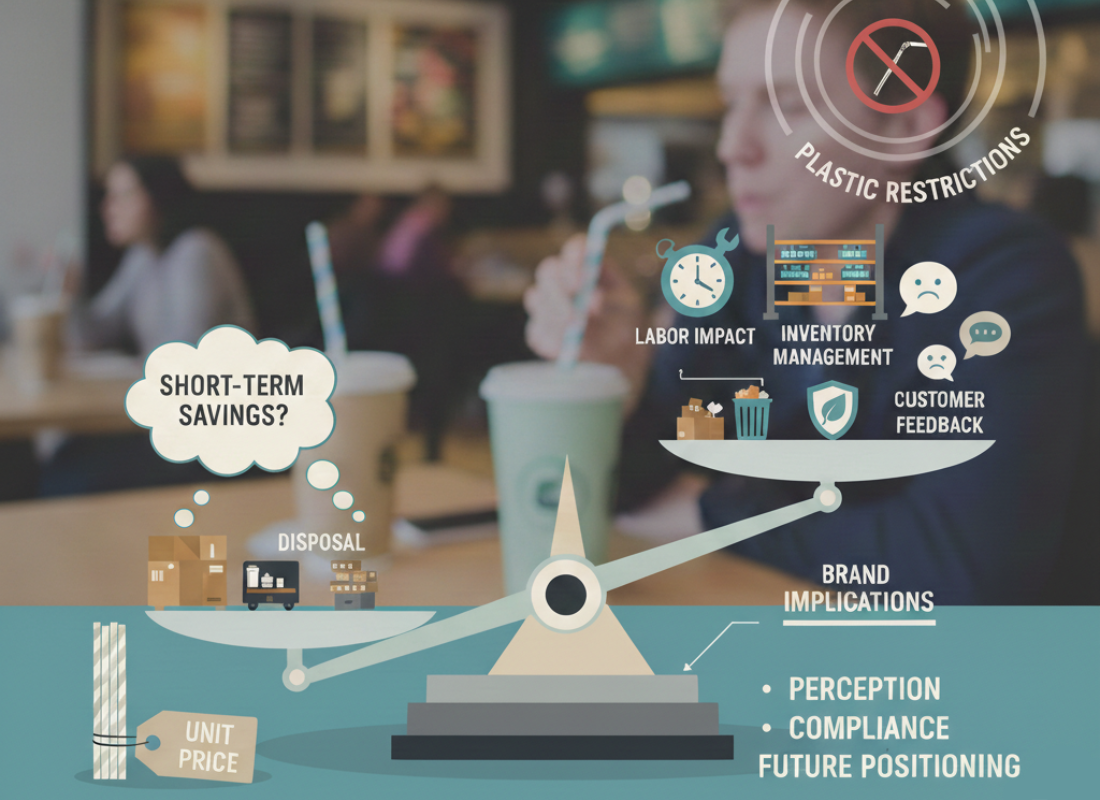
Evaluating paper straws through the lens of total cost of ownership offers a clearer perspective. Beyond unit price, operators must account for labor impact, inventory management, waste disposal, customer feedback, and brand implications.
When viewed holistically, paper straws rarely reduce short-term operational costs. Instead, they represent a strategic investment in perception, compliance, and future-facing positioning — particularly in regions where single-use plastic restrictions are tightening.
Regulation and Procurement Strategy
Regulatory pressure further shapes the cost discussion. In many markets, plastic straws are no longer an option, regardless of cost efficiency. In these environments, paper straws become a compliance requirement rather than a strategic choice. The question then shifts from whether they are cheaper to how their costs can be managed more intelligently.
From a procurement standpoint, paper straws highlight the importance of cross-functional decision-making. Sustainability initiatives are often introduced at leadership or brand level, while their operational impact is felt most acutely on the floor. Without alignment between purchasing, operations, and front-of-house teams, inefficiencies multiply.

So, Are Paper Straws Worth It?
So, are paper straws reducing or increasing operational costs? In most cases, they increase direct and indirect expenses while delivering reputational and strategic value instead. For brands serving sustainability-driven audiences, that trade-off may be worthwhile. For others, it may signal the need for more nuanced, system-level solutions.
True sustainability leadership is not about adopting visible symbols in isolation. It is about making informed decisions that balance cost, experience, and environmental impact — and designing systems that work in the real world, not just on paper.
 Beyond Paper: Choosing Smarter Straw Alternatives
The push to replace plastic straws with paper was well-intentioned, but material substitution alone does not guarantee better outcomes. In many operational settings, paper straws introduce durability issues, higher replacement rates, and increased waste.
More effective alternatives already exist. Options such as rice straws offer greater functionality, longer usability, and improved guest satisfaction while remaining biodegradable and food-safe. When paired with thoughtful usage policies, these materials can reduce overall consumption and operational friction more effectively than paper.
True sustainability comes from selecting materials that work in practice—not just in theory—while reducing unnecessary use wherever possible.