Energy Consumption in Single-Use Straw Production: A Comparative Lifecycle Perspective
Introduction: Why Energy Matters in Sustainable Product Design
Now imagine yourself on a sunny day, basking in sunrays and sipping on a cool drink as you enjoy the fresh air.
Everything seems to be just perfect: the birds are singing, the flowers in bloom are releasing a soft scent that is slowly tickling your senses and you bring the drink up, the slightly cool feel of the straw touches your lip, but have you ever stopped to think about just how much energy that little straw actually consumes?
What if I told you that the amazing scenery you were just contemplating could be put at risk by the choice of your straws? Let’s find out a little more straw production and energy consumption.
Energy consumption is one of the most decisive indicators in sustainable product development. In lifecycle assessment (LCA), energy use directly influences greenhouse gas emissions, acidification potential, photochemical ozone formation, and long-term environmental burden.
For single-use products such as drinking straws—often dismissed as trivial—energy intensity becomes particularly important because production volumes are enormous and usage duration is measured in minutes.
This Life Cycle Assessment conducted under ISO 14040 and ISO 14044 standards compared three different types:
- Rice straws (agricultural residue-based)
- Paper straws (virgin or recycled fiber)
- PLA straws (polylactic acid bioplastic derived from corn)
The results reveal substantial differences in energy consumption from raw material extraction, manufacturing, and end-of-life stages. These differences ultimately determine overall climate performance and environmental viability.
- Cradle-to-Gate Energy Demand: Production as the Critical Stage
The production stage (raw material extraction + manufacturing) accounts for the majority of total emissions across all three materials.
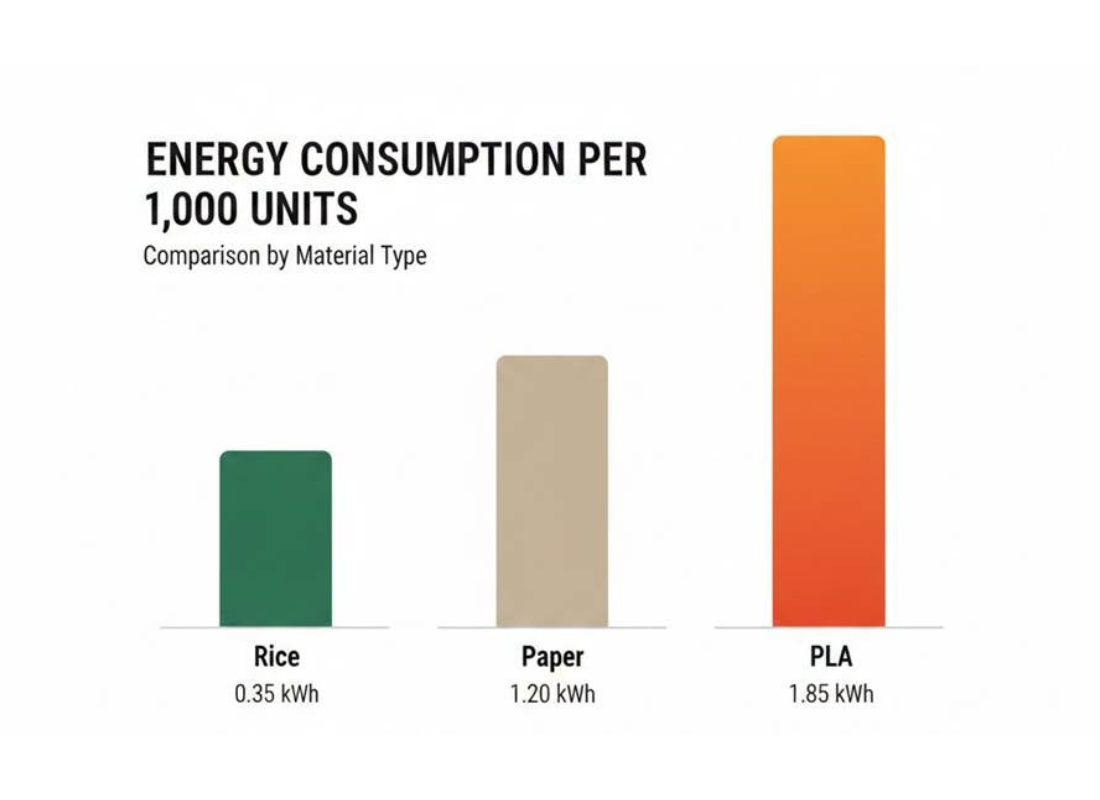
PLA requires approximately 5.3 times more energy than rice straws and 1.5 times more than paper straws. This difference is rooted in material origin and processing intensity.
- Raw Material Extraction: Embedded Energy Profiles
Rice Straws: Valorization of Agricultural Residue
Rice straws originate from agricultural residue of rice production. Since rice cultivation already occurs for food production, the straw is considered a co-product. Its environmental burden is partially allocated, reducing its effective energy footprint.
Raw material extraction emissions:
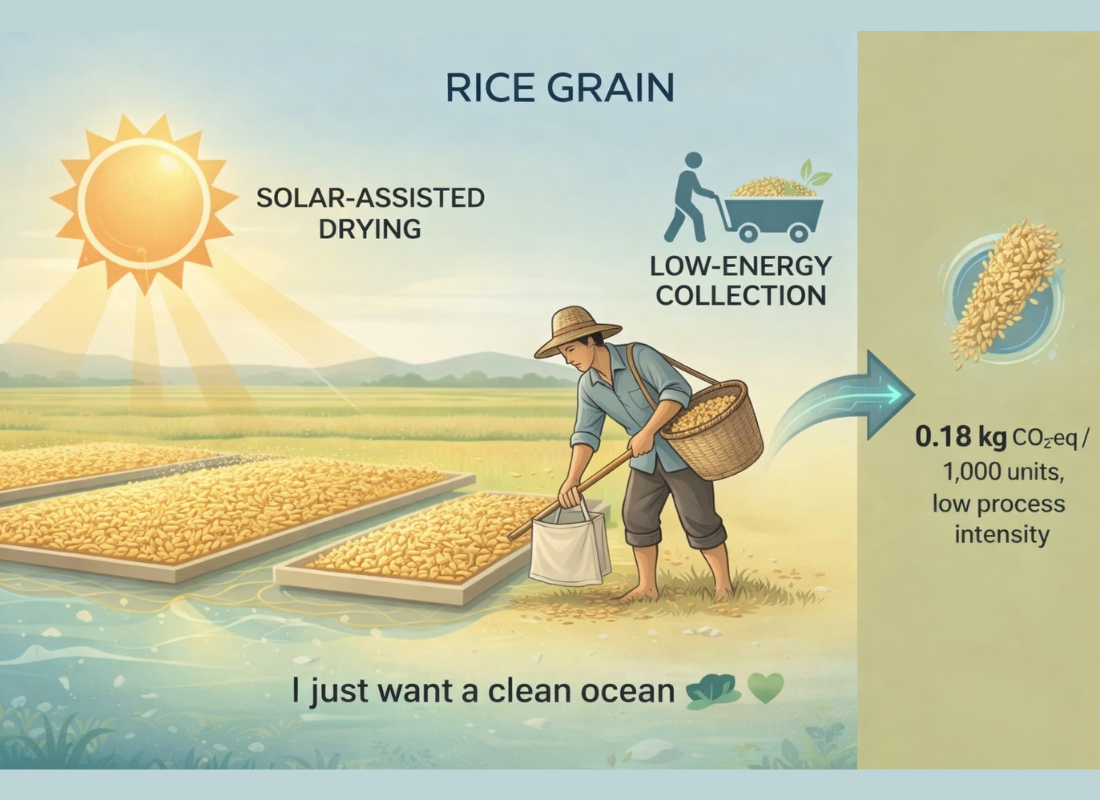
Energy inputs are minimal:
- Collection
- Drying (often solar-assisted)
- Sorting
An additional climate benefit arises because utilizing rice straw avoids open-field burning, which would otherwise release methane (CH₄) and nitrous oxide (N₂O), both potent greenhouse gases.
Energy advantage: Low process intensity and partial renewable input (approximately 40% renewable energy in agricultural contexts).
Paper Straws: Forestry and Pulping Energy Burden
Paper straws rely on forestry and pulping operations, which are energy-intensive.
Raw material extraction emissions:
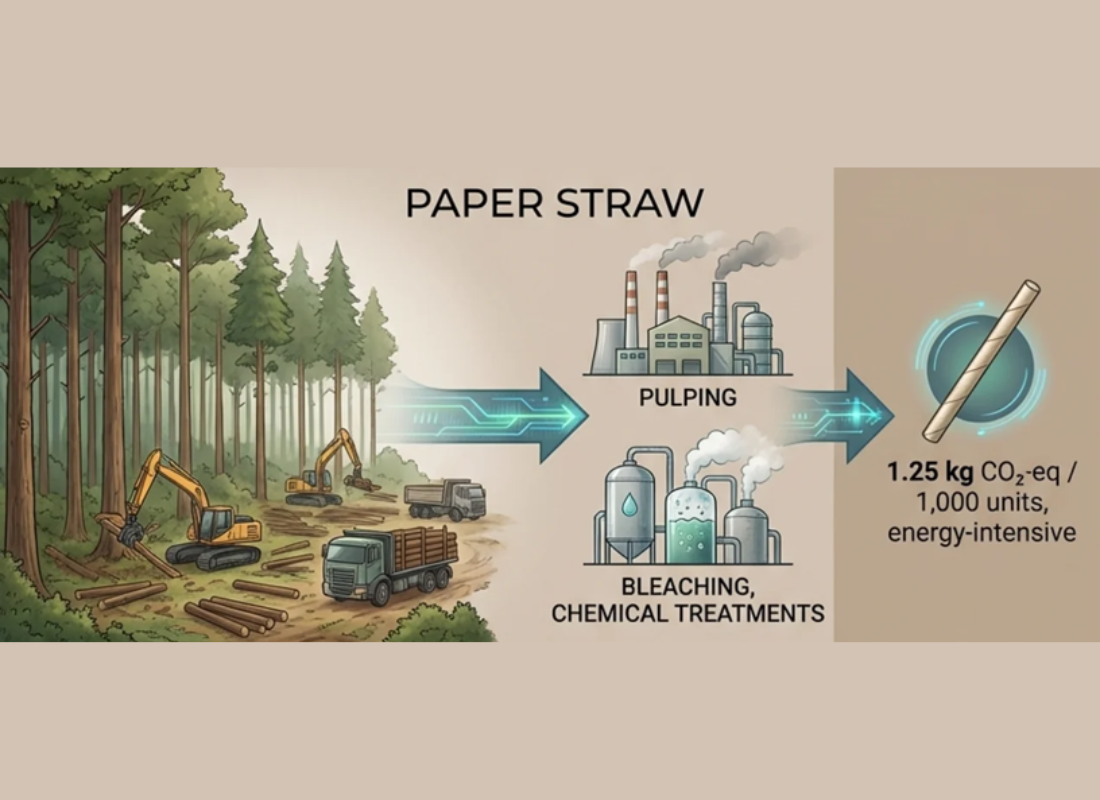
Breakdown:
- Tree harvesting and transport
- Mechanical and chemical pulping
- Bleaching processes
- Additives and chemical treatments
Pulping and bleaching are particularly energy-demanding due to thermal and chemical requirements. Water-intensive processes also increase indirect energy use (pumping, treatment, drying).
Even with recycled fiber, which reduces impact by 35–40%, paper remains substantially more energy-intensive than rice.
PLA Straws: Agricultural and Polymerization Energy Load
PLA is derived from corn, requiring:
- Fertilizers (140–160 kg N per hectare)
- Pesticides
- Mechanized farming
- Fermentation to lactic acid
- Polymerization to produce PLA resin
Raw material extraction emissions:
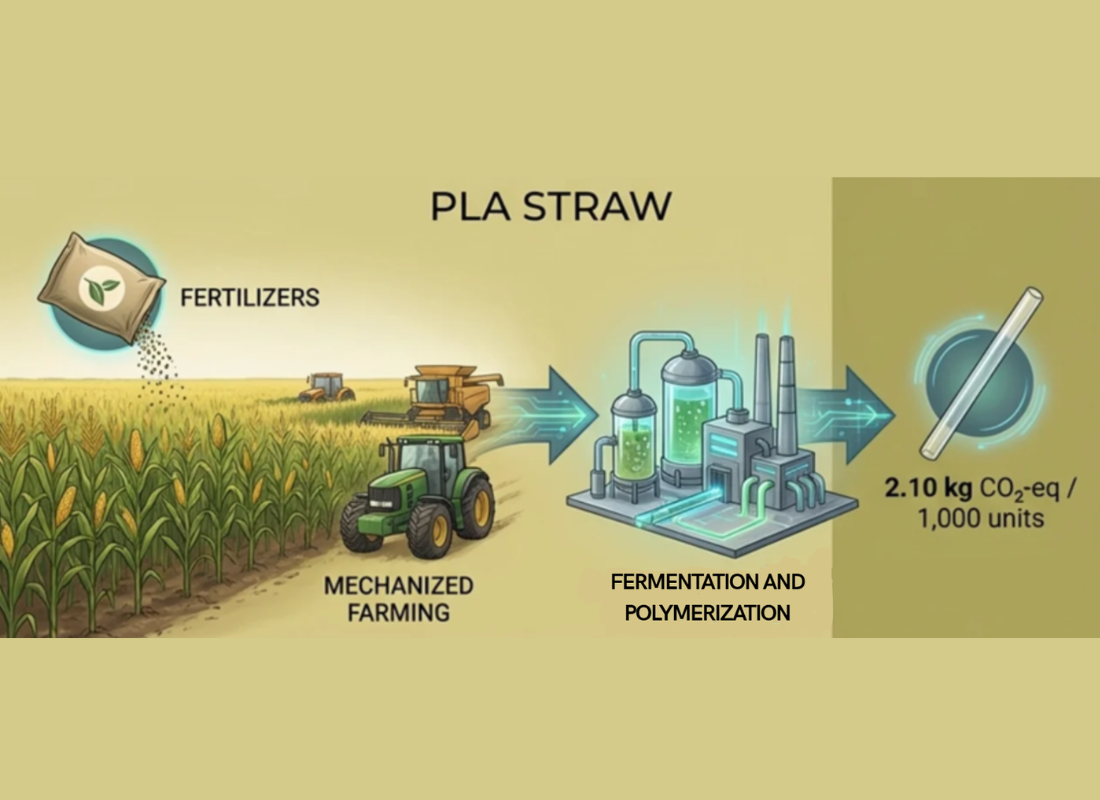
Major contributors:
- Corn cultivation (1.80 kg CO₂-eq)
- Fermentation (0.85 kg CO₂-eq)
- Polymerization (0.95 kg CO₂-eq)
This makes PLA the most energy-intensive raw material stage among the three.
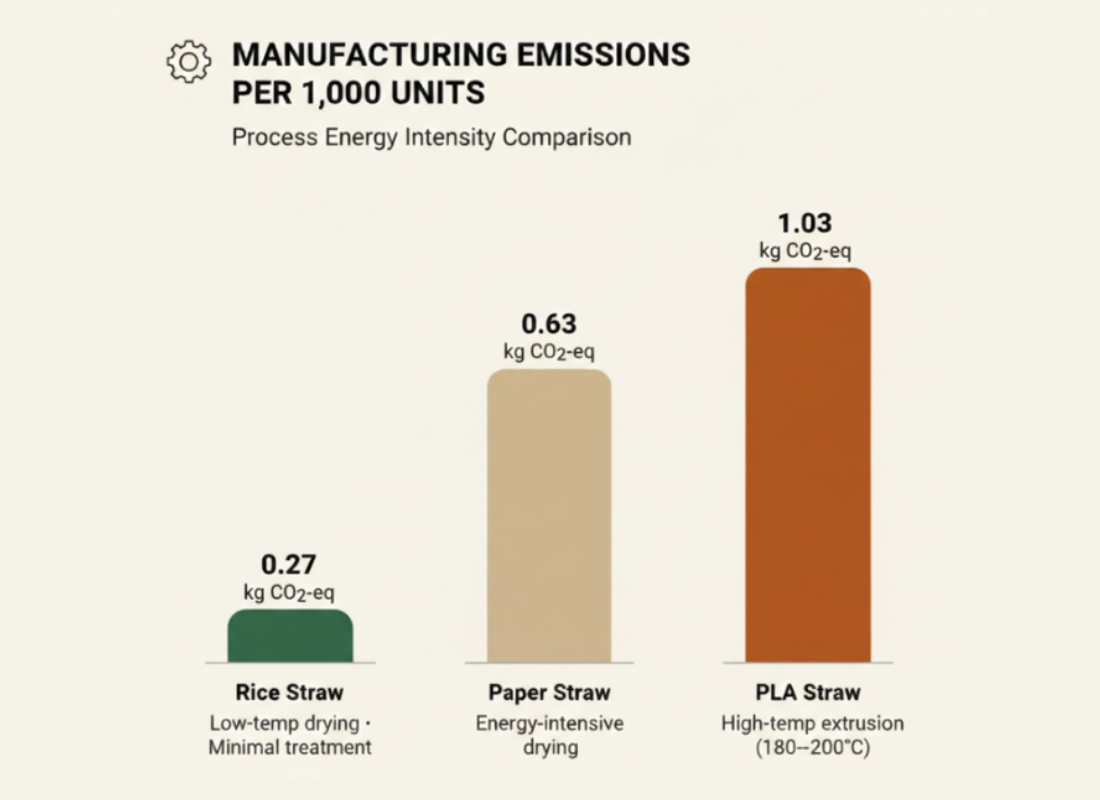
- Manufacturing Phase: Process Energy Intensity
Manufacturing energy requirements show even clearer divergence.
Rice Straw Manufacturing
Key processes:
- Low-temperature drying (0.15 kg CO₂-eq)
- Forming/shaping (0.07 kg CO₂-eq)
- Optional food-grade coating (0.05 kg CO₂-eq)
Energy demand is modest due to:
- Low processing temperature
- Minimal chemical treatment
- High production yield
- Limited waste
Paper Straw Manufacturing
Major energy drivers:
- Paper machine operation (thermal + electrical)
- Drying (most energy-intensive step)
- Rolling/forming
- Application of LDPE or wax coatings
Drying wet pulp sheets is highly energy-intensive due to water evaporation. Thermal energy demand significantly increases total emissions.
PLA Straw Manufacturing
Energy-intensive processes:
- High-temperature extrusion (180–200°C)
- Pelletization
- Electric heating, often powered by fossil fuel-based grids
PLA requires approximately 2.5 times more manufacturing energy than rice and nearly double that of paper.
- Total Lifecycle Energy-Related Emissions
Landfill Scenario (Total Emissions per 1,000 Units)
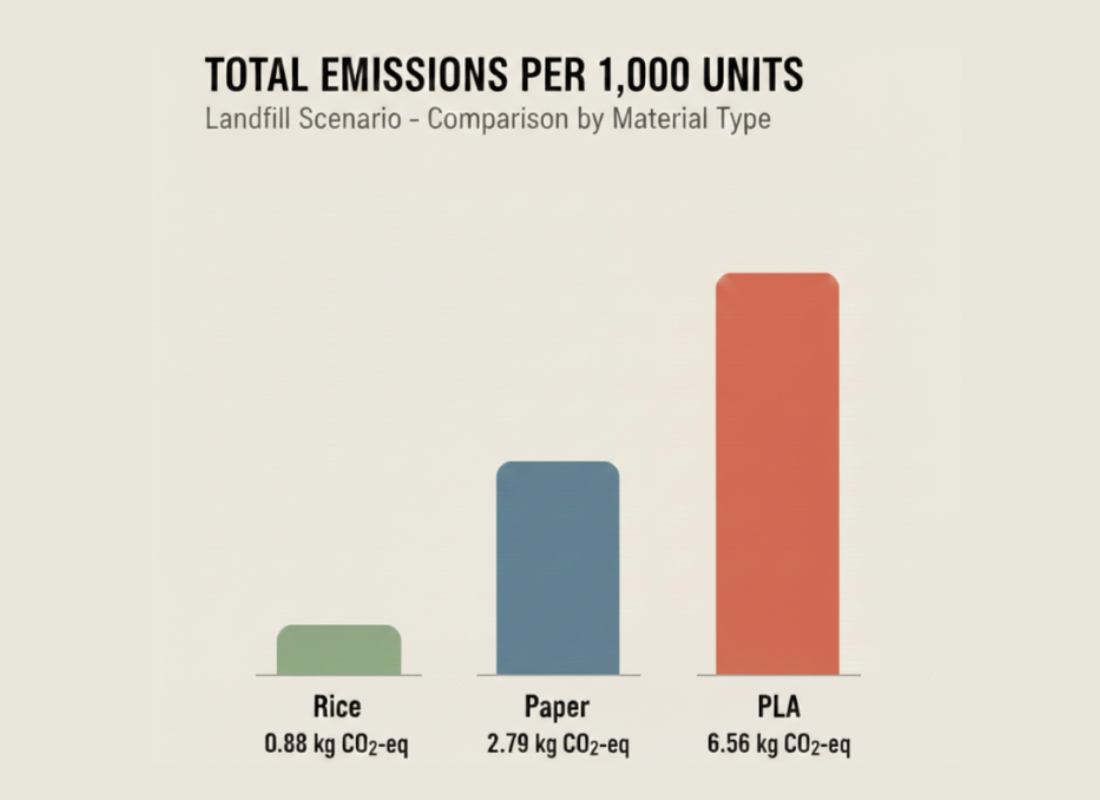
PLA emits 7.45 times more than rice under landfill conditions.
Composting Scenario
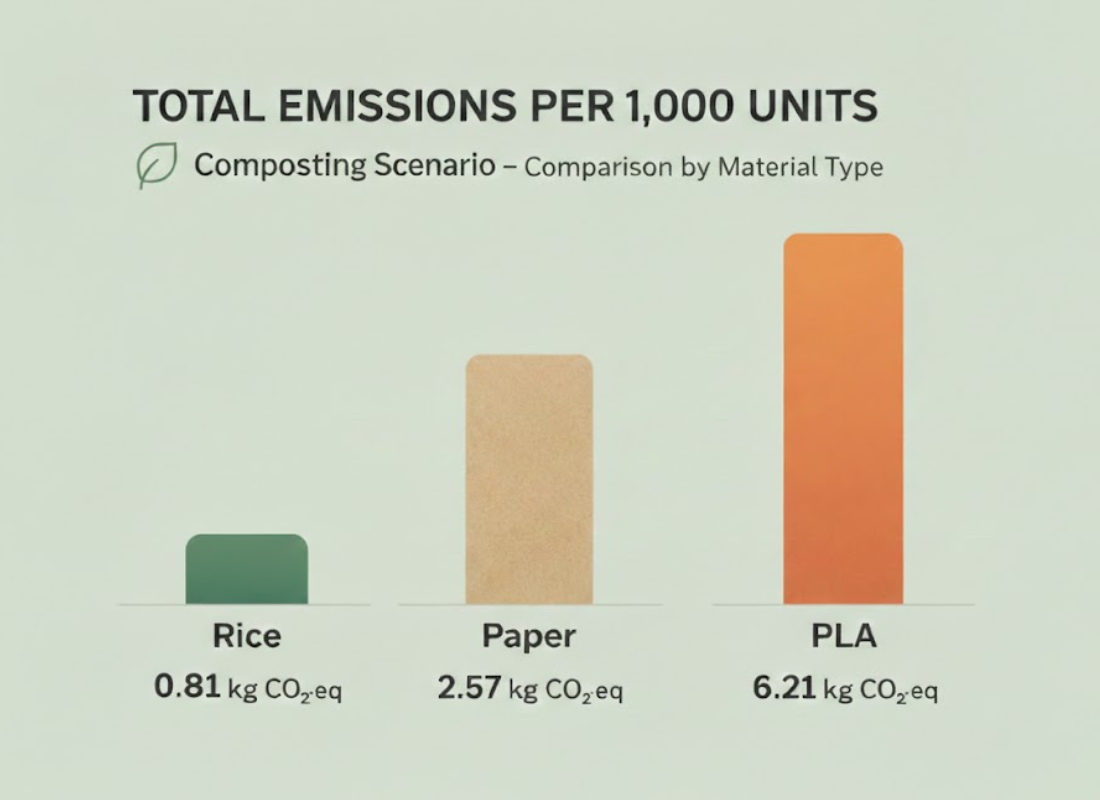
Composting reduces emissions by 8–12%, but relative rankings remain unchanged.
- Energy Efficiency Ranking
Across all phases:
Rice < Paper < PLA
Rice’s advantage stems from:
- Residue utilization
- Low-temperature processing
- Reduced chemical inputs
- Lower packaging requirements
PLA’s disadvantage stems from:
- Agricultural fertilizer intensity
- Energy-intensive polymerization
- High extrusion temperatures
- Fossil-heavy electricity grids
Conclusion: Energy as the Decisive Sustainability Lever
The lifecycle energy profile clearly establishes rice straws as the most energy-efficient option. Production accounts for over 50% of total impact across all materials, meaning upstream energy decisions dominate sustainability outcomes.
PLA, often marketed as biodegradable and environmentally friendly, performs worst due to high agricultural and polymerization energy requirements. Paper, while better than PLA, remains significantly more energy-intensive than rice.
From an energy systems perspective, agricultural residue valorization represents a structurally superior pathway to sustainable single-use products.